The California Department of Corrections and Rehabilitation (CDCR) is the state agency responsible for operating California’s adult prison system and overseeing parole operations. It manages 34 state prisons, multiple fire camps, and contracts with out-of-state facilities to house inmates when needed. CDCR’s mission includes public safety, rehabilitation, and the successful reintegration of incarcerated individuals into society. The department employs over 70,000 staff, including correctional officers, medical professionals, counselors, and administrative personnel. It operates under the California Government Code and is overseen by the Governor-appointed Secretary of Corrections and Rehabilitation.
CDCR handles all aspects of incarceration, from intake and classification to housing, healthcare, education, and release planning. Each year, the department processes tens of thousands of new admissions and releases. It also manages the California Board of Parole Hearings, which evaluates eligible inmates for parole. The agency publishes annual reports on population statistics, budget allocations, and program outcomes. CDCR’s policies are shaped by state legislation, court rulings, and ongoing reform efforts aimed at reducing recidivism and improving conditions of confinement.
CDCR Organizational Structure and Leadership
The California Department of Corrections and Rehabilitation is led by a Secretary appointed by the Governor. The Secretary oversees multiple divisions, including Adult Institutions, Parole and Community Reentry, Health Care Services, and Administrative Services. Each division is managed by a Deputy Secretary who coordinates operations across facilities. The organizational chart includes regional administrators who supervise multiple prisons within geographic zones. This structure ensures standardized policies while allowing local adaptation to facility-specific needs.
Executive Leadership and Oversight
The CDCR Secretary reports directly to the Governor and advises on correctional policy, budget requests, and emergency operations. The Secretary is supported by an Executive Team that includes Deputy Secretaries for Operations, Health Care, and Reentry. The Office of Internal Affairs investigates misconduct allegations, while the Office of the Ombudsman handles public complaints. The California Correctional Peace Officers Association (CCPOA) represents correctional staff, and labor negotiations impact staffing levels and working conditions.
- The Secretary sets strategic priorities annually, including goals for reducing violence, improving medical care, and expanding vocational training.
- Deputy Secretaries manage day-to-day operations and implement policy changes across institutions.
- The Board of Parole Hearings operates independently but under CDCR administrative support, conducting parole suitability hearings for eligible inmates.
Divisional Responsibilities
Each CDCR division has distinct functions. Adult Institutions manages all state prisons, including security levels, staffing, and facility maintenance. Parole and Community Reentry supervises individuals released on parole, including GPS monitoring and employment assistance. Health Care Services provides medical, dental, and mental health treatment, operating under court-mandated standards due to past litigation. Administrative Services handles budgeting, human resources, and information technology systems.
- Adult Institutions: Oversees 34 prisons, 43 fire camps, and 13 contract facilities.
- Parole and Community Reentry: Manages parole officers, reentry centers, and transitional housing programs.
- Health Care Services: Operates medical clinics in every prison and contracts with external providers for specialty care.
Regional Administration
CDCR divides the state into five regions: Northern, Bay Area, Central Valley, Southern, and Out-of-State. Each region has a Regional Administrator who coordinates emergency response, staff training, and facility audits. Regional offices also handle inmate transfer logistics and visitation scheduling. This decentralized model improves responsiveness but requires strict adherence to statewide policies to maintain consistency.
| Region | Number of Prisons | Primary Office Location |
| Northern | 8 | Sacramento |
| Bay Area | 6 | San Quentin |
| Central Valley | 10 | Stockton |
| Southern | 8 | San Diego |
| Out-of-State | 2 | Eloy, AZ |
California State Prison System Detail
California operates the largest state prison system in the United States, with a design capacity of approximately 85,000 beds. As of 2023, the population exceeds 95,000 due to court-ordered population caps and ongoing reform efforts. The system includes maximum, medium, and minimum-security facilities, as well as specialized institutions for women, youth, and inmates with medical or mental health needs. Each prison is classified by security level and housing type, which determines staffing ratios and operational protocols.
Prison Security Levels and Classification
CDCR uses a point-based classification system to assign inmates to appropriate facilities. The score ranges from 0 to 52+, with higher scores indicating greater security needs. Factors include crime severity, violence history, gang affiliation, escape risk, and disciplinary record. The classification board reviews each case and assigns a security level. This score can change during incarceration based on behavior, program participation, or disciplinary actions.
- Level 1: Open dormitories, low perimeter security, typically fire camps or minimum-security facilities. Score: 0–18.
- Level 2: Open dormitories with secure perimeter and armed coverage. Score: 19–27.
- Level 3: Secure perimeter, armed coverage, cell housing not adjacent to exterior walls. Score: 28–51.
- Level 4: Maximum security with internal and external armed coverage, cell block housing. Score: 52+.
Facility Types and Specialized Institutions
Beyond standard prisons, CDCR operates specialized facilities. The California Medical Facility (CMF) in Vacaville provides long-term medical care. The California Health Care Facility (CHCF) in Stockton serves inmates with chronic illnesses. Female inmates are housed at institutions like the California Institution for Women (CIW) and Valley State Prison for Women. Youthful offenders are processed through the Division of Juvenile Justice, though most are now under county supervision due to recent reforms.
- Reception Centers: Process new inmates for 60–120 days, including medical screening, classification, and orientation.
- Fire Camps: Minimum-security facilities where inmates work on wildfire suppression and conservation projects.
- Contract Facilities: Two Arizona prisons house California inmates to reduce overcrowding.
Population Statistics and Trends
California’s prison population peaked at over 170,000 in 2006. Reforms like Proposition 47 (2014) and Public Safety Realignment (2011) shifted low-level offenders to county jails, reducing the state population. As of 2023, the population is approximately 96,000. Recidivism rates remain around 45% within three years of release. CDCR publishes quarterly population reports showing breakdowns by gender, age, race, and offense type.
| Year | Total Population | Design Capacity | Overcrowding Rate |
| 2006 | 173,000 | 85,000 | 203% |
| 2015 | 133,000 | 85,000 | 156% |
| 2023 | 96,000 | 85,000 | 113% |
California Inmate Information and Lookup Tools
CDCR provides a public inmate search tool to locate individuals in state custody. The system allows searches by name or CDC number and displays current location, release date, and housing status. This service is available 24/7 and updated daily. It does not include county jail inmates, federal prisoners, or those in private facilities not under the CDCR contract.
How to Use the CDCR Inmate Search Tool
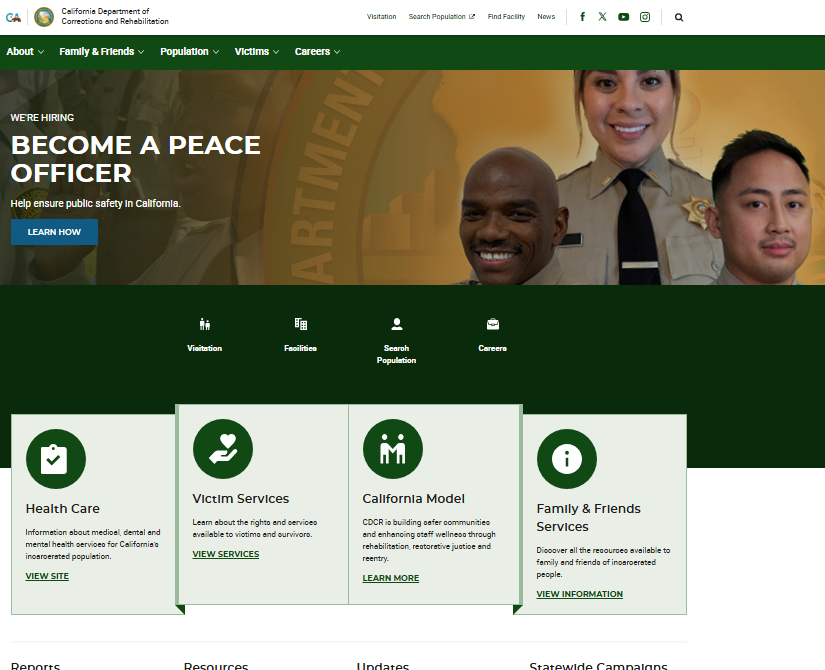
To find an inmate, go to the official CDCR Inmate Locator at https://www.cdcr.ca.gov/. Type the inmate’s first and last name in the “First Name” and “Last Name” fields. Alternatively, enter the CDC number in the “CDC Number” field. Click the “Search” button. The system will return the inmate’s current institution, housing unit, projected release date, and parole eligibility date. If no results appear, the person may be in the county jail or released.
- Open the Inmate Locator page.
- Enter the full name or CDC number in the correct field.
- Click “Search” and review the results.
The Search Results
The search results display key data points. “Institution” shows the prison name and address. “Housing Unit” indicates the specific building or cell block. “Projected Release Date” is an estimate based on sentencing and good behavior credits. “Parole Eligibility Date” shows when the inmate can first be considered for parole. The system does not show disciplinary history, medical status, or visitation records. For additional details, contact the prison’s records office directly.
- Name: Full legal name as recorded at intake.
- CDC Number: Unique 6-digit identifier assigned upon entry.
- Institution: Current prison location (e.g., “San Quentin State Prison”).
- Housing Unit: Specific dorm or cell block (e.g., “Building C, Cell 12”).
- Projected Release Date: Estimated date based on sentence and credits.
- Parole Eligibility Date: Earliest date parole can be considered.
Limitations and Accuracy
The inmate locator is updated once per day, typically overnight. Transfers between facilities may not appear for 24–48 hours. Inmates in reception centers may not be searchable until classification is complete. The tool does not include inmates in federal custody, county jails, or out-of-state facilities not under the CDCR contract. For real-time updates, call the prison’s public information officer. Always verify information with official staff before making travel or financial arrangements.
California Prison Visitation Policies and Procedures
Visitation in California state prisons requires pre-approval and scheduling. Each facility sets its own visiting days, hours, and rules. Visitors must be on the inmate’s approved list and pass a background check. Minors must be accompanied by a legal guardian. All visitors must present a valid photo ID and may be subject to search. Failure to follow rules can result in suspension of visiting privileges.
Applying for Visitation Approval
To visit an inmate, submit a Visitor Application (Form CDCR 1088) to the prison’s visiting office. The inmate must initiate the request by submitting the form on your behalf. Include your full name, address, date of birth, relationship to the inmate, and government-issued ID number. The application is reviewed within 30 days. Approval depends on criminal history, prior rule violations, and facility capacity. Denials can be appealed through the prison’s grievance process.
- Inmate submits Form CDCR 1088 to the visiting office.
- The visitor provides ID and completes background screening.
- The application is reviewed by the classification staff.
- Approval or denial notice is mailed to the visitor.
Visitation Rules and Conduct
Each prison publishes a visiting schedule and a rulebook. Typical visiting hours are weekends and holidays from 8:00 AM to 3:00 PM. Visitors must arrive 30 minutes early for processing. No cell phones, bags, or electronic devices are allowed. Physical contact is limited to a brief hug at the beginning and end of the visit. Food and drinks must be purchased from the prison canteen. Inmates may not receive packages during visits.
- Allowed items: Clear plastic container for personal items, baby formula in original container, prescription medication in labeled bottle.
- Prohibited items: Weapons, drugs, alcohol, tobacco, cameras, recording devices, and outside food.
- Dress code: No revealing clothing, gang-related symbols, or clothing resembling staff uniforms.
Special Visits and Exceptions
Special visits may be granted for emergencies, medical reasons, or family events. These require written approval from the warden. Attorneys may visit during business hours with prior notice. Religious leaders can conduct services or private meetings. Minors under 18 must have a notarized letter from the non-visiting parent if only one guardian is present. All special visits are logged and subject to monitoring.
| Visit Type | Approval Required | Frequency |
| Regular | Yes | Weekly or biweekly |
| Legal | Yes | As needed |
| Emergency | Warden | One-time |
| Religious | Yes | Scheduled |
California Prison Programs and Rehabilitation Services
CDCR offers a range of programs aimed at reducing recidivism and supporting reentry. These include education, vocational training, substance abuse treatment, and mental health services. Participation can improve classification scores and parole eligibility. Programs are funded through the state budget and federal grants. Availability varies by facility and security level.
Education and Vocational Training
All prisons offer basic education, including GED preparation and adult basic education. Vocational programs include carpentry, welding, auto repair, and culinary arts. Some facilities partner with community colleges to offer associate degrees. Inmates earn certificates upon completion, which can improve job prospects after release. Enrollment is based on space, behavior, and classification level.
- GED Program: Free for inmates without a high school diploma.
- Vocational Certificates: Offered in 15+ trades across the system.
- College Courses: Available at select prisons via online platforms.
Substance Abuse and Mental Health Services
CDCR operates the Substance Abuse Treatment Services (SATS) program, offering counseling, group therapy, and medication-assisted treatment. Mental health services include psychiatric evaluations, medication management, and crisis intervention. Inmates with serious mental illness may be housed in specialized units. All facilities have licensed clinicians on staff.
- Intake screening identifies treatment needs.
- Treatment plans are developed within 14 days of admission.
- Ongoing care includes individual and group sessions.
Reentry and Life Skills Programs
Reentry programs begin 18 months before release. They include job readiness training, financial literacy, and family reunification support. The California Reentry Program (CRP) helps inmates obtain ID documents, housing, and employment. Parole agents assist with transition planning. Success is measured by reduced recidivism and employment rates post-release.
| Program | Duration | Eligibility |
| GED | 6–12 months | No diploma |
| Welding | 9 months | Level 1–3 |
| SATS | 6–24 months | Substance use history |
| CRP | 18 months | Release within 2 years |
California Department of Corrections Jobs and Careers
CDCR employs a wide range of professionals, from correctional officers to medical staff and administrators. Jobs are posted on the official CDCR Careers page. Applicants must pass background checks, medical exams, and training programs. Salaries vary by role, with correctional officers earning between $50,000 and $90,000 annually. Benefits include health insurance, retirement plans, and paid leave.
Correctional Officer Recruitment
Correctional officers are the largest employee group. To apply, visit https://www.cdcr.ca.gov/careers/ and search for “Correctional Officer I.” Submit an application, pass a written exam, and complete a physical agility test. Successful candidates attend the 16-week Academy in Galt, California. Training covers firearms, defensive tactics, and emergency response.

- Minimum age: 21
- Education: High school diploma or GED
- Background: No felony convictions
- Training: 16 weeks at the Academy
Medical and Mental Health Staff
CDCR hires physicians, nurses, psychiatrists, and counselors. Positions require state licensure and relevant experience. Nurses work in prison clinics, providing primary and emergency care. Psychiatrists manage medication and conduct evaluations. Mental health counselors lead therapy groups and crisis intervention. Salaries are competitive with private sector roles.
- Apply through the CDCR Careers portal.
- Submit license verification and transcripts.
- Complete interview and background check.
Administrative and Support Roles
Administrative jobs include human resources, budgeting, and information technology. These roles support prison operations and require office skills. Support staff includes cooks, maintenance workers, and clerks. Many positions are unionized under the California State Employees Association. Advancement is based on performance and seniority.
| Job Title | Starting Salary | Training Required |
| Correctional Officer I | $58,000 | 16 weeks |
| Registered Nurse | $95,000 | License + orientation |
| Psychiatrist | $220,000 | License + 2 weeks |
| IT Specialist | $75,000 | Certification preferred |
California Prison Healthcare and Mental Health Services
CDCR provides medical and mental health care under court supervision due to past failures. The system operates under the Plata v. Brown settlement, which mandates timely access to care. Each prison has a medical clinic staffed by doctors, nurses, and specialists. Emergency care is available 24/7. Mental health services include screening, treatment, and housing for seriously ill inmates.
Medical Care Delivery
Upon intake, inmates receive a health screening within 14 days. This includes physical exams, lab tests, and dental assessments. Chronic conditions like diabetes and hypertension are managed with regular monitoring and medication. Specialty care, such as cardiology or orthopedics, is provided through telemedicine or off-site referrals. Prescription drugs are dispensed through on-site pharmacies.
- Intake screening: Completed within 14 days.
- Chronic care: Monthly check-ups for ongoing conditions.
- Emergency care: Available at all times via on-site staff or hospital transfer.
Mental Health Treatment
Mental health screening occurs at intake and during classification. Inmates with symptoms are referred to clinicians. Treatment includes individual therapy, group sessions, and medication. Seriously mentally ill inmates may be placed in Enhanced Outpatient Programs (EOP) or inpatient psychiatric units. Suicide prevention protocols are enforced, including constant observation for high-risk individuals.
- Screening at intake identifies mental health needs.
- Treatment plans are developed within 7 days.
- Ongoing care includes medication and therapy.
Oversight and Compliance
The federal court monitors CDCR healthcare through a Special Master. Regular audits assess timeliness, quality, and staffing. Reports are published annually. Inmates can file grievances if care is delayed or denied. The Office of Health Care Quality Improvement reviews all complaints. Non-compliance can result in court sanctions or increased oversight.
| Service | Standard | Compliance Rate (2023) |
| Intake screening | Within 14 days | 98% |
| Chronic care visits | Monthly | 92% |
| Mental health intake | Within 14 days | 95% |
| Emergency response | Immediate | 99% |
California Prison Reform, Lawsuits, and Policy Changes
CDCR has undergone significant reforms due to court rulings and legislative changes. Key cases include Brown v. Plata (2011), which ordered population reduction due to unconstitutional overcrowding. Reforms have focused on reducing recidivism, improving healthcare, and expanding rehabilitation. Policies are shaped by the California Legislature, court orders, and public advocacy.
Major Court Cases and Rulings
Brown v. Plata was a landmark Supreme Court case that found California’s prison conditions violated the Eighth Amendment. The court ordered the state to reduce the population to 137.5% of design capacity. This led to Public Safety Realignment in 2011, shifting low-level offenders to county jails. Other cases have addressed use of force, solitary confinement, and disability rights.
- Brown v. Plata (2011): Ordered population reduction.
- Plata v. Brown (ongoing): Monitors healthcare compliance.
- Armstrong v. Brown: Requires accommodations for disabled inmates.
Legislative Reforms
Recent laws have reduced sentences for non-violent crimes and expanded parole eligibility. Proposition 47 (2014) reclassified drug possession and petty theft as misdemeanors. Proposition 57 (2016) allows earlier parole for non-violent offenders. Senate Bill 136 (2016) eliminated mandatory minimums for certain drug offenses. These changes have reduced the prison population by over 40,000 since 2011.
- Prop 47: Reduced sentencing for drug and theft crimes.
- Prop 57: Expanded parole opportunities.
- SB 136: Eliminated mandatory minimums for drug offenses.
Current Policy Initiatives
CDCR is implementing the California Model, which emphasizes rehabilitation over punishment. This includes expanding education, reducing solitary confinement, and improving staff training. The department is also increasing transparency through public dashboards and annual reports. Future goals include closing older prisons and investing in community-based alternatives.
| Initiative | Goal | Status |
| California Model | Rehabilitation focus | Ongoing |
| Solitary Reduction | Limit isolation | Implemented |
| Prison Closure | Close 5 facilities | Planned by 2025 |
California Department of Corrections Contact Information
For general inquiries, contact the CDCR Public Information Office. For inmate-specific questions, call the individual prison. All correspondence should include the inmate’s name and CDC number. Emergency contacts are available 24/7 for family notifications.
| Address | 1515 S Street, Sacramento, CA 95811 |
| Phone | (916) 445-6714 |
| Hours | Monday–Friday, 8:00 AM – 5:00 PM |
(FAQs) About the California Department of Corrections and Rehabilitation
The following frequently asked questions provide clear and practical information about the California Department of Corrections and Rehabilitation (CDCR), including how to locate inmates, understand prison procedures, and learn about visitation, classification, and reentry programs. These answers are designed to help families, legal representatives, and the public quickly understand key aspects of the California state prison system.
How do I find out if someone is in a California state prison?
Use the CDCR Inmate Locator at https://inmatelocator.cdcr.ca.gov/. Enter the person’s full name or CDC number in the designated fields and click “Search.” The system will show their current institution, housing unit, projected release date, and parole eligibility. If no results appear, the person may be in county jail, federal custody, or released. The database updates daily, so recent transfers may not appear immediately. Always verify information with the prison’s records office if planning a visit or sending mail.
What happens during the first 120 days in a California prison?
New inmates go through a reception and classification process lasting up to 120 days. During this time, they undergo medical and mental health screenings, security assessments, and orientation. They cannot make phone calls or receive packages, but they can receive mail. The classification board reviews their criminal history, behavior, and risk factors to assign a security level. After approval, they are transferred to a permanent facility. This process ensures proper placement but may delay contact with family.
Can I visit an inmate during the reception period?
Yes, visitation is allowed during reception, but you must be on the approved visitor list. The inmate must submit a Visitor Application (Form CDCR 1088) on your behalf. You will need to pass a background check and provide a valid ID. Visits are scheduled in advance and follow the same rules as regular visits. However, privileges may be limited until classification is complete. Contact the reception center directly for specific visiting hours and procedures.
How are security levels assigned in California prisons?
Security levels are based on a point system ranging from 0 to 52+. Points are assigned for factors like crime severity, violence history, gang affiliation, escape risk, and disciplinary record. A score of 0–18 places an inmate in Level 1 (minimum security), 19–27 in Level 2, 28–51 in Level 3, and 52+ in Level 4 (maximum security). The classification board reviews each case, and scores can change based on behavior or program participation. This determines housing type, staffing levels, and movement restrictions.
What programs are available to help inmates prepare for release?
CDCR offers reentry programs starting 18 months before release. These include job training, GED classes, substance abuse treatment, and life skills workshops. The California Reentry Program helps inmates obtain ID documents, find housing, and connect with employment services. Parole agents assist with transition planning. Participation can improve classification scores and parole chances. Programs vary by facility, but all aim to reduce recidivism and support successful reintegration.